

Australia’s Most Dangerous Animals (And the One Nobody Talks About)
They say that in Australia, every creature can kill you. And while that belief isn’t completely unfounded—because yes, there are some deadly animals here—I don’t think it paints a particularly accurate picture of the country either.
Have I come across spiders bigger than the palm of my hand? Definitely. In fact, one of them lived in my living room for a while. Have I been chased by a dingo looking for food in the desert? Yep, that too. I’ve seen a redback spider (also known as the Australian black widow), been stung by a jellyfish while snorkelling, almost stepped on a snake that chose to take a nap right in the middle of a hiking trail, and discovered that leeches can grow up to three centimetres long...
Okay, maybe that’s not exactly reassuring. Oops! But keep reading, because despite all these—and other—interesting encounters with Australian wildlife, I want to explain why I don’t think this is actually such an accurate image of Australia.
Oh! And most importantly, I’ll reveal which Australian animal really is dangerous—and the one you should actually watch out for, even though nobody seems to talk about it.
MOST DANGEROUS ANIMALS IN AUSTRALIA
WHICH ANIMALS CAUSE THE MOST DEATHS IN AUSTRALIA
*This post may contain affiliate links. If you book your trips through them, I may receive a small commission at no extra cost to you that will be used to keep updating the content on this blog. Cheers!
THE DEADLIEST ANIMALS IN AUSTRALIA
Australia is home to some of the deadliest animals on the planet. The taipan, the box jellyfish, the funnel-web spider, and the stonefish are considered among the most venomous animals of their kind.
The cone snail and the blue-ringed octopus can also be added to the list of marine animals whose venom can be lethal.
And let’s not forget the larger predators: sharks and saltwater crocodiles, or the cassowary, one of the most aggressive birds in the world and the animal species most closely related to dinosaurs.
But which animals actually cause the most deaths in Australia?
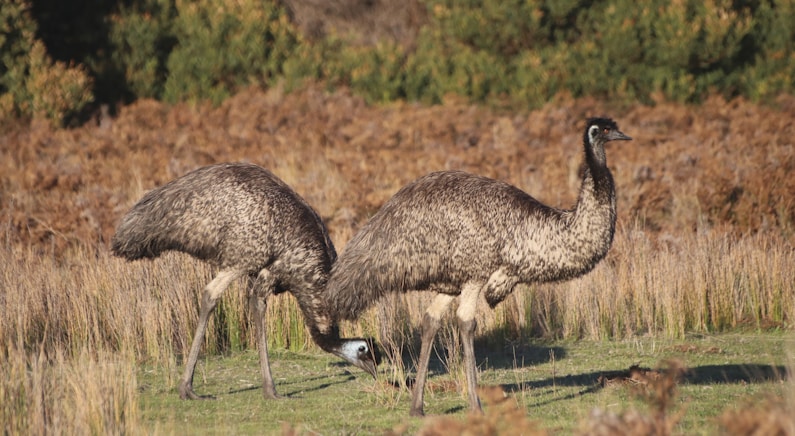

An emu tried to steal food from the back of my car when I was camping in Monkey Mia.
THE ANIMALS THAT CAUSE THE MOST DEATHS IN AUSTRALIA
According to data from NCIS Australia, the animals responsible for the most fatal accidents in Australia aren’t sharks or any of the other animals you might be thinking of. The animals that kill the most people in Australia are horses and cattle. Yep, you read that right! And next on the list are other mammals, including dogs and kangaroos. Did you expect that?
A large number of these accidents are related to falls, while others happen on the road. Kangaroos and other wild mammals are more active at night, which is why driving after sunset is strongly discouraged. Especially if you're going on a road trip through the Australian Outback, I can assure you that you don't want to come across a giant buffalo in the middle of the road.

Deaths caused by animals in Australia (2001-2017)
According to these figures, between 2001 and 2017, horses were responsible for 172 deaths in Australia, compared with just 27 deaths caused by sharks. That's more than six times as many deaths from horses as from sharks!
AUSTRALIA’S MOST DANGEROUS CREATURE — The Only One You Really Need to Worry About
Now, I’m not saying you shouldn’t be careful when you’re walking through the bush, or that you should casually stick your hand under a rock in the desert without checking what might be hiding underneath. (Rule number one for the intrepid hiker: never put your hand somewhere you can’t see what’s there.)
I’m also not going to encourage you to go swimming at beaches in northern Queensland or the Northern Territory, because even if you can’t see one, there could very well be a crocodile lurking nearby. Yes, saltwater crocodiles are a thing! They can grow up to six metres long and have the strongest bite of any animal in the world.
But none of that is the animal I’m talking about.
Because there’s one creature in Australia that can catch you completely off guard. You don’t need to go hiking through the bush, swimming in tropical waters, or poking around under rocks to encounter it.
It could be there when you least expect it: cycling to work on a sunny spring morning, or heading out for a run with your music blasting.
And you might not even see it coming.
Any idea what animal I’m talking about?
Here’s a clue:
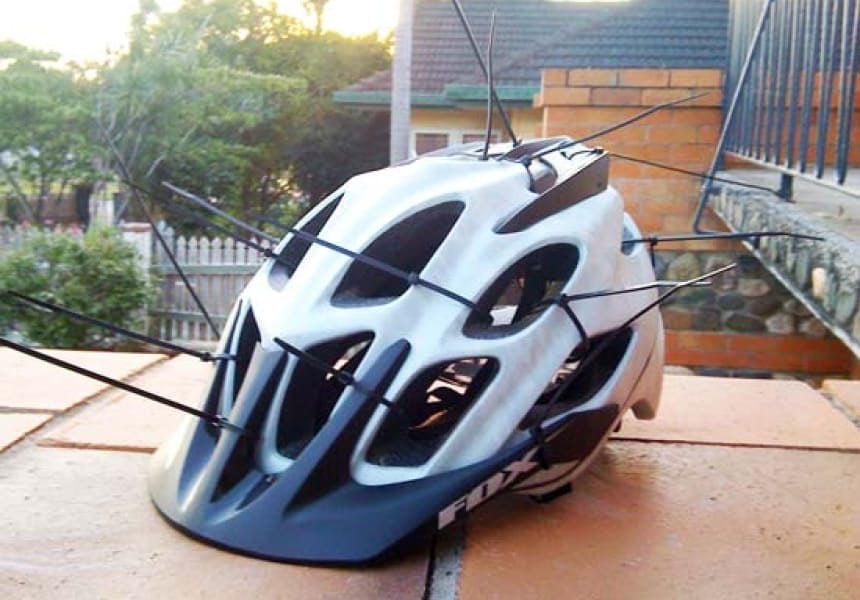
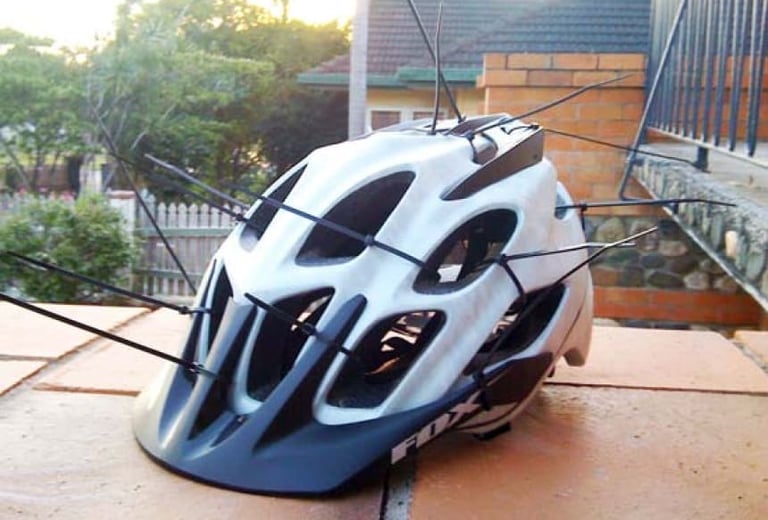
Bicycle helmets in Australia
If that doesn’t give you any clues, let me explain. When spring arrives, this helmet suddenly becomes a very popular accessory across large parts of Australia.
Why? Well, take a look at this video from @9newsmelbourne. Hopefully, you’ll be able to watch it without any problems.
And once you’ve seen it, I think you’ll understand exactly what I mean…
That devilish bird is a magpie — THE MOST DANGEROUS ANIMAL IN AUSTRALIA.
And I’m not just saying that. I have a friend who was attacked by one and ended up with three holes in her head, blood all over her hair and neck, and completely in shock when she got home. Luckily, it wasn’t serious, but what a scare.
Magpies breed in spring, and the males become extremely protective. Some will chase and attack anyone they perceive as a threat, which is often people running or cycling near their nests.
And the scariest part? THEY REMEMBER YOUR FACE FOR YEARS.
So if you ever get chased by one, the best thing you can do is change your route and avoid the area where that particular little bird lives.
Not spiders, not snakes, not sharks. The magpie is the only animal that has ever made me feel genuinely in danger in Australia. Because yes, I’ve been chased by a magpie too while cycling.
Luckily (and because I already knew what to do: keep riding!), it didn’t actually hurt me. But I stopped cycling for a while afterwards, and I became slightly paranoid every time I heard birds singing.
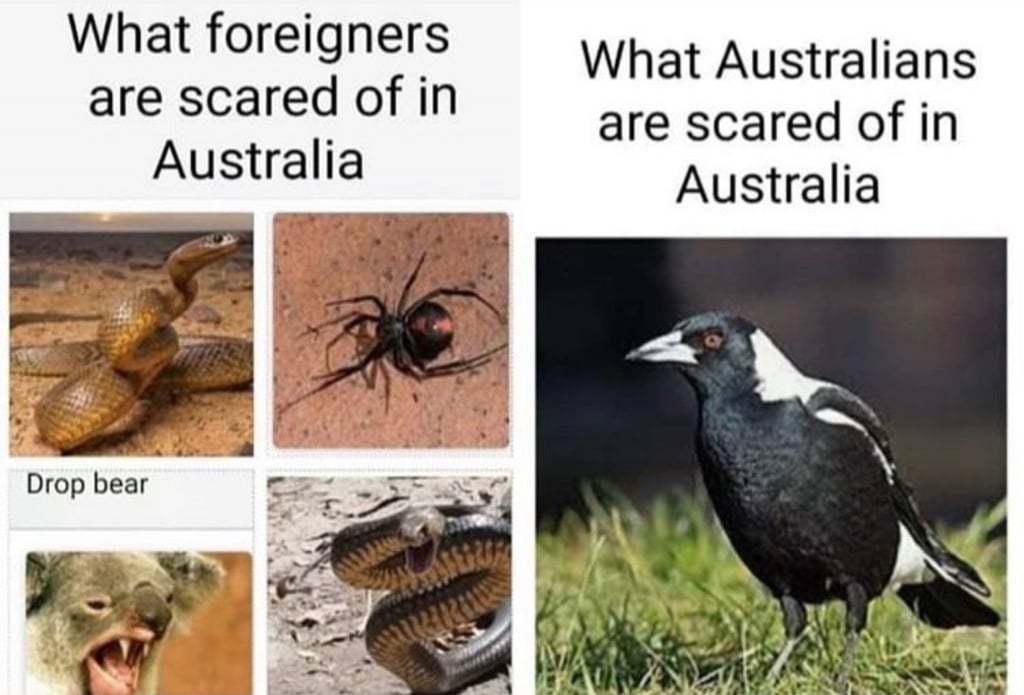
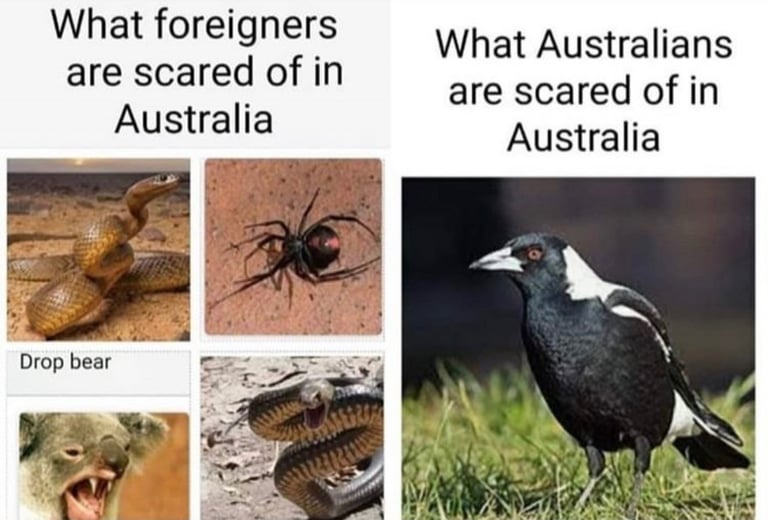
This meme could summarize this article
TIPS: HOW TO SURVIVE AUSTRALIA'S DANGEROUS WILDLIFE
Spiders in Australia
How to get a giant spider out of your room: you’ll need a Tupperware container and a piece of cardboard that’s bigger than the container.
Place the Tupperware over the spider, keeping it pressed firmly against whatever surface the spider is on—wall, floor, table, etc.
Slowly slide the cardboard underneath the container, starting at one edge.
Keep sliding until the cardboard completely covers the opening.
Now the spider is safely trapped inside. Pick up the container, take it outside, and release it in the garden.
There you go: spider removed, crisis averted.
Or, alternatively, call your Aussie neighbour. They’ll probably be used to this and might even find the whole situation hilarious. Then invite them for a cold one afterwards (that’s Australian for a beer).
Camping in the bush can be amazing. Being far from civilisation, having a campfire, toasting marshmallows and telling stories around the fire… what’s not to love? But there is one small detail to keep in mind: the 15 cm spider that might decide to hide under your car bonnet while you sleep.
At some point, it may crawl out and give you the fright of your life (not that this has ever happened to me… or maybe it has).
To avoid unwanted surprises, keep your car doors and windows closed, and if you leave your shoes outside, always check inside them before putting them on. Basically, give anything that’s been sitting outside a quick check before you stick your hands or feet in it.
DISCLAIMER: After a year of camping all over Australia, this only happened to me once, in a forest in New South Wales. After driving for an hour, a Huntsman emerged from under the bonnet and started walking across the front windscreen (on the outside).
We got rid of it, and at the next stop, an EVEN CREEPIER spider climbed into the car when we opened the back door.
Nightmare.
If it happens to you, refer to the Tupperware technique.
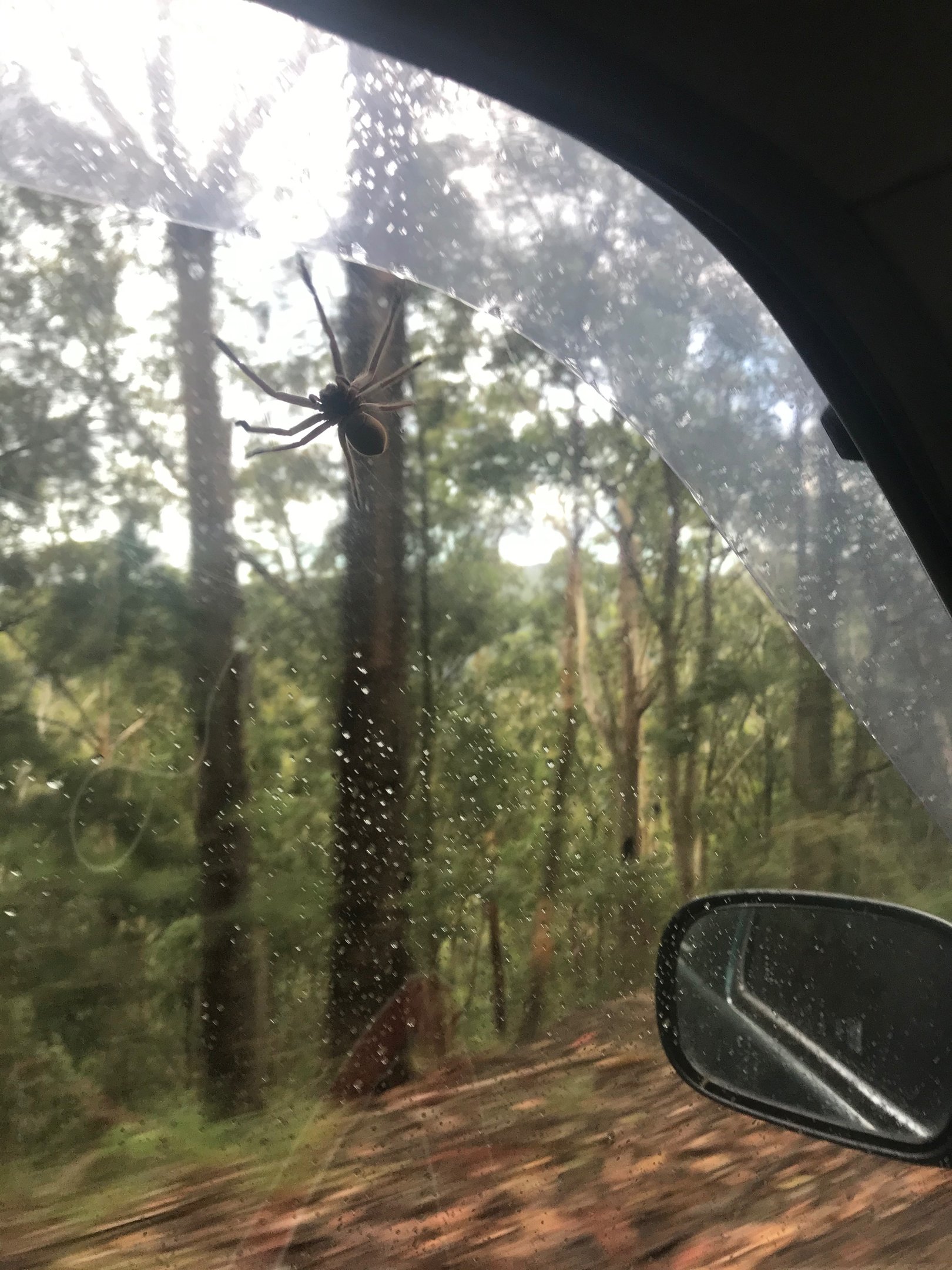
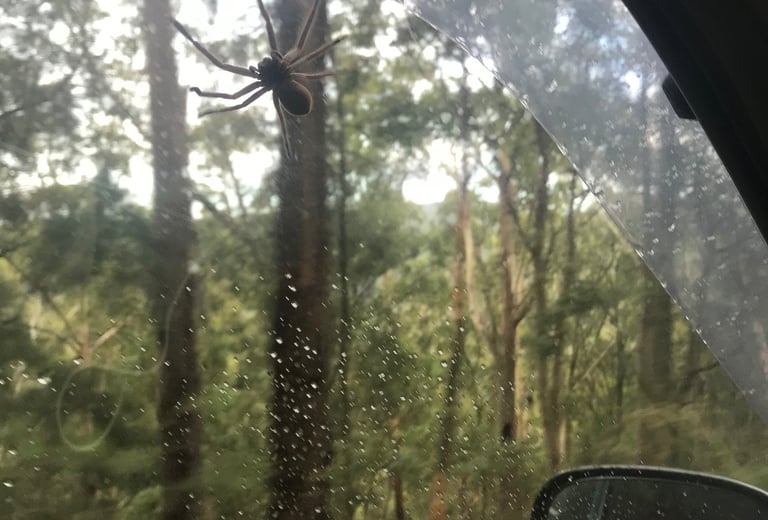
I'm in the car, she's outside. But 10 cm away from my face.
Crocodiles in Australia
According to a girl I worked with at this seaside resort in Darwin, saltwater crocodiles watch for repeated patterns in order to make their attacks more successful. In other words, if you go fishing somewhere one day, you’re probably not in as much danger. But if you go back to the exact same spot the following day, the chances of a crocodile coming after you are supposedly much higher.
Either way, don’t risk it. The best advice is simply to stay out of the water throughout tropical northern Australia.


Crocodiles are very good at watching you without being noticed
Sharks in Australia
The great white shark can be found along Australia’s coastline, and shark attacks on surfers are real—and more common than I expected. In 2020, there was an unusually high number of attacks: 22 in total. Before surfing anywhere, keep an eye on local news and check for recent shark sightings in the area.
Speaking of sharks, don’t even think about swimming in the canals of the Gold Coast. They are home to bull sharks, which are known for their aggressive behaviour.
>> What I learned while swimming with one of the most dangerous sharks in the world
Snakes in Australia
Australia is home to around 100 venomous snake species, but one of the most dangerous is the brown snake, as it can be more defensive and unpredictable than species that simply try to escape.
The rule to remember is as follows: If the snake is green and up in a tree, all fine. If it’s brown or black and on the ground, get out of there. Either way, the safest thing to do is always the same: keep your distance and leave the snake alone.
Australia's Wild Dogs
Dingoes are Australia’s wild dogs and can be found in the desert. They can become aggressive when searching for food (and there have been attacks on humans), so it’s important to be careful if one approaches you.
A dingo once chased me when I was working in the mines because I was carrying a rubbish bag with food scraps inside. I dropped the bag and kept walking until I got inside a building. Honestly, I don’t think it would have hurt me, but I wasn’t about to stick around and find out.
Jellyfish in Australia
Stinger season in tropical Australia—along the east and northern coasts—coincides with the hottest months, generally from November to May. You’ll often find bottles of vinegar at the entrances to beaches in these areas.
If something does happen, Australia’s emergency number is 000.


SO, IS AUSTRALIA REALLY THAT DANGEROUS?
With this article, I was hoping to convince you to stop seeing Australia as such a dangerous place… although I may have accidentally achieved the exact opposite.
But I promise you, despite all these stories and encounters, I’ve never felt that Australia is such a wild or dangerous place. Quite the opposite! Everything is very well regulated. If there’s a potential danger in an area, you’ll usually be warned quickly, signs will be put up, and precautions will be taken. The Aussies have it under control!
You’d have to be pretty unlucky to come across one of Australia’s most deadly animals. These encounters are far from common, and they definitely shouldn’t put you off visiting Australia!
To make up for all that talk of deadly creatures, I invite you to read my post about Australia’s most incredible animals. I’ll even tell you exactly where you can see them in the wild!


Plan your trip to Australia
If you book your trips using these links, you get to enjoy some discounts and I may receive a small commission to keep updating the content on this blog. Cheers!
FLIGHTS - the cheapest combinations.
TRAVEL INSURANCE with 5% off.
NOMAD INSURANCE for long term travel and Working Holidays.
ESIM FROM $4,50 and get $3 off.
FREE WISE TRAVEL CARD for money transfers and minimal fees abroad.
ACTIVITIES in Australia.
RENT A CAR in Australia.
CAMPERMATE - free app to find campsites, public toilets, trekkings...
STUDENT VISA in Australia.
Recommended for you

© 2022 AMANECER POR AHÍ | Terms of use | Cookies policy | Privacy policy
hello@amanecerporahi.com