

Free Camping in Australia: Where to Camp for Free + Travel Tips
If you spend some time in Australia, you’ll quickly notice that camping is a big part of the Australian way of life. Australians love spending time outdoors, and the country is incredibly well set up for camping, with everything from basic bush campsites to well-equipped campgrounds.
But if you’re travelling around Australia, it’s easy to have a few questions: Where can you camp? Can you camp for free? And how do you know whether you’re actually allowed to stay overnight?
In this guide, I’ll explain how camping works in Australia, where you can find free campsites, and what to expect from the experience.
GUIDE TO CAMPING IN AUSTRALIA
How To Find Campsites: Apps & Webs
Is Free Camping Allowed In Australia?
Free Camping etiquette
RENTING OR BUYING A VEHICLE FOR FREE CAMPING IN AUSTRALIA
The first step when planning a road trip around Australia is choosing the right vehicle, as it may become your home for days, weeks or even months.
Most travellers either rent a campervan or motorhome or, if they’re staying in Australia for longer, buy a second-hand car or campervan.
The vehicle you choose can make a big difference when it comes to finding places to stay overnight. Here are a few things to keep in mind:
A motorhome or campervan gives you more comfort and facilities, such as a bed, kitchen and, in some cases, a toilet and shower. However, larger vehicles can be more difficult to drive and may not be suitable for unsealed or remote roads. Also, having a vehicle with its own facilities doesn’t mean you can camp anywhere for free: you still need to follow the rules of the area you’re visiting.
If you’re planning to sleep in a tent, you’ll generally have fewer options for free camping than if you sleep inside your vehicle or in a rooftop tent. Many free overnight areas are specifically intended for people travelling in vehicles, while camping with a tent may only be permitted in designated campsites.
A 4WD isn’t essential for most Australian road trips or free campsites, but it can be a huge advantage if you’re planning to explore remote areas of Western Australia or the Northern Territory. Some beaches, tracks and more isolated campsites can only be reached safely with a 4WD, particularly after rain.
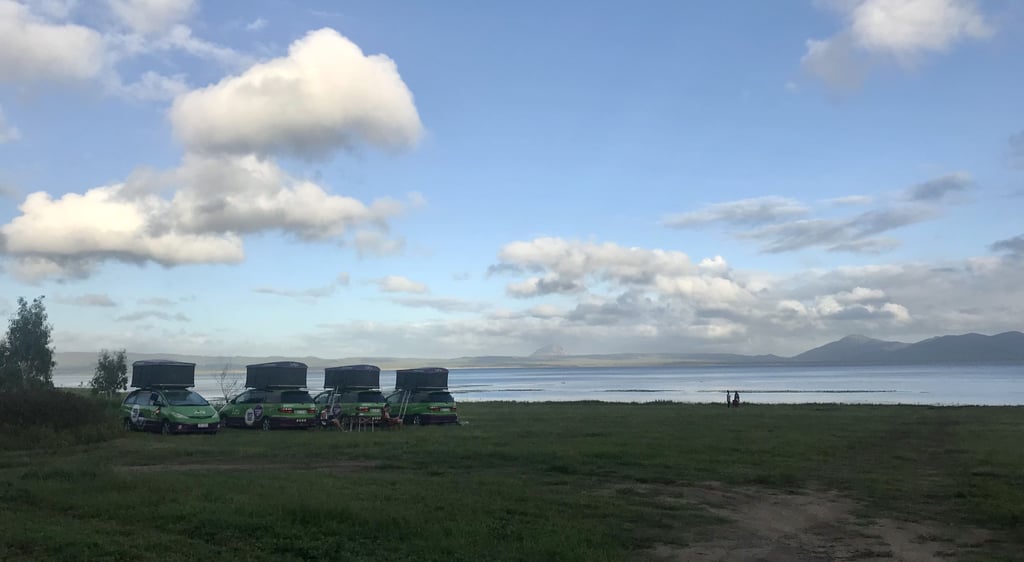
Me and my friends rented four campervans for a camping trip in Queensland, at Lake Proserpine
TYPES OF CAMPSITES IN AUSTRALIA (Free & Paid)
Australia has several different types of places where you can spend the night, with varying levels of facilities and, of course, different costs. These are some of the most common options, starting with the most basic:
1. Roadside Rest Areas (free)
Roadside rest areas are usually simple places to pull over and take a break from driving. Some have little more than a parking area, while others may have toilets, picnic tables, rubbish bins or other basic facilities.
Some rest areas allow overnight stays, often with a maximum stay of 24 hours. Always check the signs at the specific rest area, as some are intended only for short stops and aren't designated for camping or overnight stays.
You'll also come across heavy vehicle rest areas, which are designed primarily for truck drivers to take mandatory fatigue breaks. If you're travelling in a campervan or car, it's best to avoid taking up these spaces, especially where parking is limited.
Always follow the signs and local rules, and don't assume that because a place looks suitable for camping, you're allowed to spend the night there.


Motorhomes parked at a roadside rest area in the Australian Outback
2. Free Campsites
These are generally a step up from roadside rest areas, with more space and basic facilities such as shade, picnic tables, toilets, fire pits, barbecues or water. However, the facilities vary enormously from one campsite to another, and some free camps have little more than a designated area to park.
You'll find free campsites in different types of public land across Australia, although the rules depend on the state, local council or land manager. Some are first come, first served, while others may require you to register or obtain a permit.
It's very important to follow the rules at each campsite, respect the environment and take all your rubbish with you. Responsible camping helps keep these places available for future travellers.
3. Paid Campsites in National Parks
Many national parks across Australia have designated campsites, ranging from very basic bush camps to more developed campgrounds with toilets, showers, picnic areas and other facilities.
Don't expect luxury at the more remote campsites. Many have only basic facilities because they're designed to have as little impact on the surrounding environment as possible. But that's also part of the appeal: you can spend the night surrounded by some of Australia's most beautiful landscapes.
Camping fees vary significantly depending on the state, national park and campsite. Some campsites are free, while others charge a small fee per person, vehicle or campsite. In many cases, you'll need to book and pay online in advance, although some sites still operate on a first-come, first-served basis.
The money collected from camping and park fees helps support the management, maintenance and conservation of these protected areas.
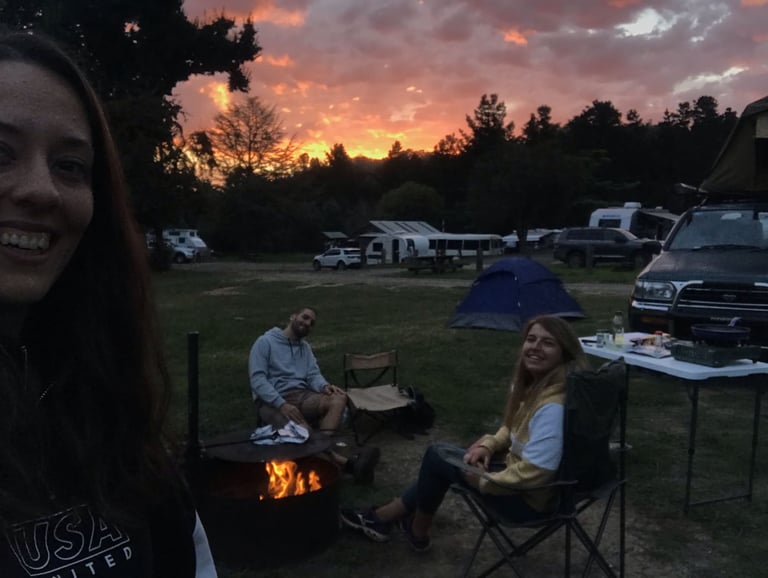
Enjoying a campfire while camping in Hill End, NSW
4. Private Campgrounds
Just because you have to pay to camp somewhere in Australia doesn't necessarily mean you'll get lots of facilities. Private campgrounds come in all shapes and sizes, from very basic properties with little more than a place to pitch your tent or park your vehicle to more developed sites with toilets, showers, kitchens and other facilities.
Prices vary considerably depending on the location, facilities and time of year, so it's difficult to give a reliable nationwide price range. Basic unpowered sites can still be relatively affordable, while campsites in popular tourist destinations will cost considerably more.
5. Caravan Parks
Caravan parks are generally among the most comfortable and well-equipped camping options in Australia. They usually offer a range of facilities such as powered and unpowered sites, toilets, hot showers, kitchens, laundry facilities, drinking water and dump points. Many also have swimming pools, playgrounds or other amenities.
They're more expensive than basic campsites, particularly in popular destinations and during peak periods. Many caravan park groups and membership organisations also offer discounts and loyalty programs for members.
Ultimately, the better equipped you are and the less you depend on external facilities such as barbecues, drinking water or bathrooms, the more flexibility you'll have when looking for places to camp for free.
And that's one of the best things about camping in Australia: you don't need a fancy setup to enjoy some incredible places.
HOW DO I FIND CAMPSITES IN AUSTRALIA?
Camping apps in Australia
The most useful apps for finding places to stay while travelling around Australia are WikiCamps and CamperMate. WikiCamps is a paid app, while CamperMate is free.
Both can help you find a wide range of free and paid campsites, as well as useful facilities and points of interest for travellers, such as public toilets, showers, water refill points and dump points.
WikiCamps is particularly useful for planning a road trip. It has thousands of listings across Australia, with filters that allow you to search specifically for things like free campsites, powered sites, water, pet-friendly locations and other facilities. It also has an offline mode, which is very handy when you're travelling through remote areas with little or no phone reception.
One of the best features of these apps is the reviews and photos left by other travellers. They can give you a much better idea of what to expect than the basic listing alone. You might find useful information about the condition of an access road, whether a campsite is suitable for a particular type of vehicle, how busy it gets or even whether there are lots of mosquitoes at certain times of the year.

CamperMate listing for a free campsite
Although there are plenty of WikiCamps fans who are more than happy to pay the roughly $10 for the app, I have to say that I never felt like I was missing information or options when using CamperMate alone.
My personal tip: I wouldn't download both apps. Deciding where to sleep each night already takes enough time, and one app gives you more than enough options. You really don't want to spend two hours a day reading campsite reviews. Trust me.
Australia's National Parks Websites
As well as using camping apps, it's worth checking the official national parks websites for each state and territory. These are the best places to check the current rules, campsite availability, fees and booking requirements for official campgrounds.
Google Maps
If you can't find anything in the area you're interested in, Google Maps can also be surprisingly useful. Try searching for terms such as “rest area”, “campground” or “campsite”. You may come across places that don't appear in the camping apps.
However, don't assume that a place is legal to camp at just because it appears on Google Maps. Use it to discover potential spots, then check the signs at the location or the relevant government website to make sure overnight camping is actually permitted.
SO, IS FREE CAMPING ALLOWED IN AUSTRALIA?
We've already seen that there are plenty of places where you can camp for free in Australia, but most of the examples so far have been designated campsites or specific areas where overnight stays are permitted.
If what you want is to set up camp wherever you find a beautiful spot, things aren't quite that simple. As a general rule, you can't just camp anywhere you like in Australia, and you can be fined if you camp somewhere you're not permitted to.
The rules vary depending on the state and the type of land, but Victoria is one of the main exceptions. In many of its national parks, state forests and reserves, free bush camping is allowed outside designated campsites, provided you follow the specific rules for that area. This makes Victoria one of the easiest states in Australia for finding more remote, free camping spots.


Laundry day at the free campsite at Carcoar Dam, NSW
Free Camping Etiquette in Australia
Leave no rubbish.
Take your toilet paper with you.
Don't empty wastewater onto the ground.
Don't damage vegetation.
Keep noise down.
Respect other campers.
Don't light fires when fire restrictions apply.
Leave the site as you found it.
Don't stay longer than permitted.
Don't occupy spaces intended for trucks.
IS FREE CAMPING IN AUSTRALIA SAFE?
Australia is generally a very safe country, and camping is no different. Of course, there are some places where you should take a little more care, particularly in and around Alice Springs and some remote communities and towns in the Northern Territory and Western Australia. In those areas, it's worth being a little more cautious about where you leave your vehicle and where you spend the night.
That said, I never felt unsafe while free camping in Australia. Most of the time, you'll simply be sharing a campsite with other travellers, including plenty of Grey Nomads — the name commonly used for retired Australians who travel around the country in their caravans.
And don't be surprised if an Australian travelling in a 4WD pickup comes to your rescue when you have a problem. They always seem to have a toolbox for every possible situation and are usually more than happy to help!


Check out my Australian Outback Roadtrip from Adelaide to Darwin!
WHAT IS THE BEST TIME FOR A CAMPING ROADTRIP IN AUSTRALIA?
Finally, keep in mind that when you travel can have a big impact on your camping experience.
One of the busiest periods to travel around Australia is during the school holidays. When Australian families take to the roads, popular attractions get busier and campsites fill up quickly. There are four main school-holiday periods throughout the year: around Easter, in late June/ early July, in September/October, and over Christmas. The exact dates vary between states and territories, so it's worth checking the calendar for the state you're travelling through.
Summer is also a popular time for domestic and international travel, particularly around Christmas and New Year, so prices can be higher and popular campsites may need to be booked well in advance.
The other major factor to consider is the weather. Australia is enormous and has several different climate zones, so the best time for a road trip depends very much on where you're going.
This is particularly important in the tropical north, where the wet season generally runs from around November to April. Heavy rain, high humidity and tropical cyclones can affect travel, and some roads and attractions may be inaccessible during the wet season. For road trips through places such as Cairns, Darwin and Broome, the dry season is the more popular time to travel, roughly from April to October.
There are small towns such as Broome and Exmouth that become extremely busy during their peak season. Especially during school holidays, plan ahead and book campsites and accommodation early, or you'll be in trouble!


Sleeping under the stars at a free campsite in Australia
Over two years of travelling around Australia by car, I've camped in all kinds of places: free campsites, paid campgrounds, beautiful spots surrounded by nature and even dusty patches of ground right next to the highway.
And although I've loved many of them, I have to say that I definitely have a favourite. And the best part? It's completely free!
Have a look at the most magical place I've ever camped in Australia. I'll give you a clue... it's in Western Australia!
See you out there!

Plan your trip around Australia
If you book using these links, you will enjoy some discounts and I may receive a small commission to keep updating the content on this blog. Cheers!
FLIGHTS - the cheapest combinations.
TRAVEL INSURANCE with 5% off.
NOMAD INSURANCE for long term travel and Working Holidays.
ESIM FROM $4,50 and get $3 off.
FREE WISE TRAVEL CARD for money transfers and minimal fees abroad.
ACTIVITIES in Australia.
RENT A CAR in Australia.
CAMPERMATE - free app to find campsites, public toilets, trekkings...
STUDENT VISA in Australia.
Recommended for you

© 2022 AMANECER POR AHÍ | Terms of use | Cookies policy | Privacy policy
hello@amanecerporahi.com